Introduction
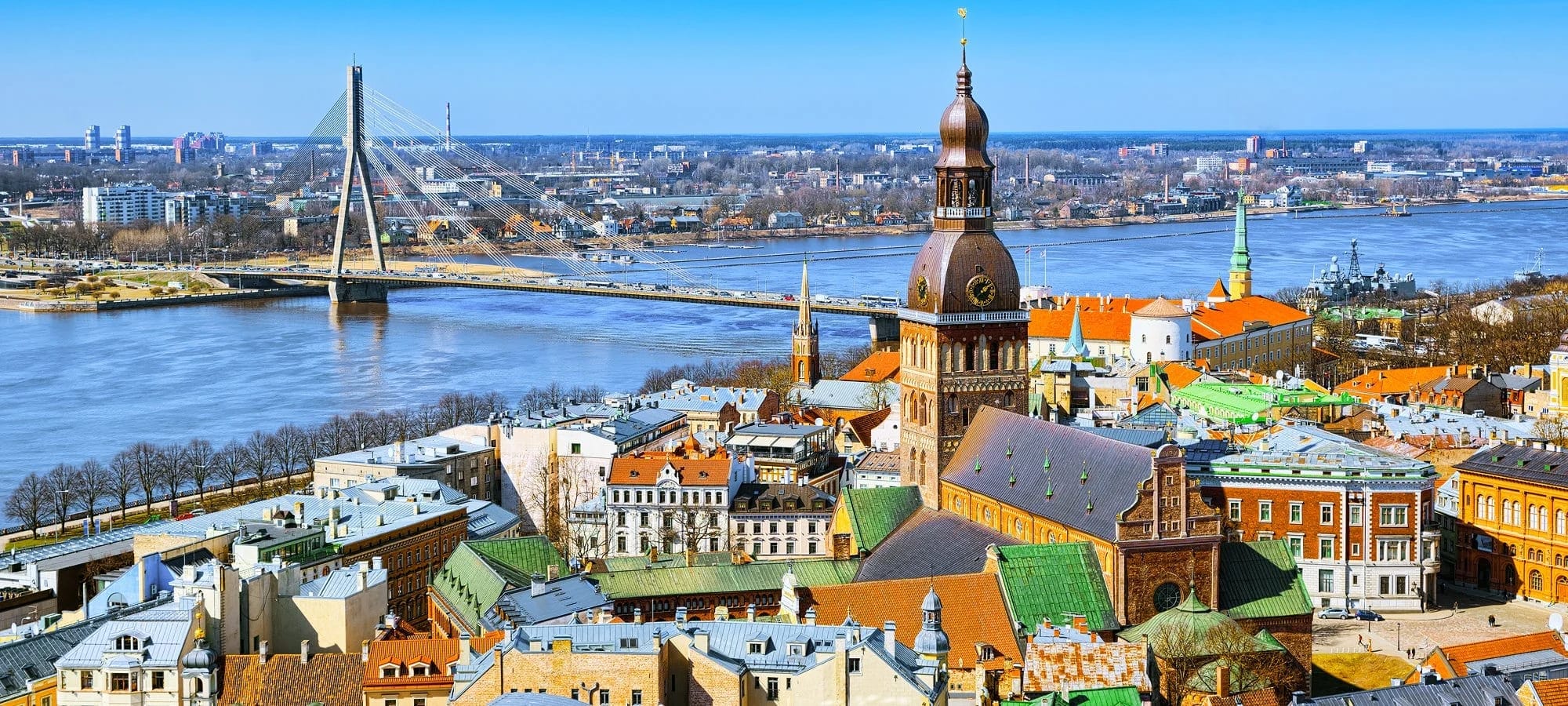
Latvia sits at the centre of the Baltic states, between Estonia and Lithuania, and is a member of both the EU and the eurozone. Its capital, Riga, is the largest city in the region. The economy returned to solid growth in 2025, with GDP up 2.1 percent, driven by household spending and strong wage gains. Growth is expected to slow in 2026 as higher energy prices weigh on demand, with forecasts of 1.4 to 2.0 percent. Latvia combines a business landscape made up almost entirely of small companies, a growing e-commerce and parcel market, and a capital city that serves as a natural base for the whole Baltic region. Together, these make it an attractive market for a master franchise in business services.
A Familiar Market for International Franchises
International franchise brands are well established in Latvia, and most have entered through experienced regional partners. As in the rest of the Baltics, franchising is strongest in fast food and casual dining, where a handful of groups hold the rights to develop brands across all three countries.
Examples of international brands in Latvia include:
- Hesburger, the Finnish burger chain, which has around 50 restaurants in Latvia
- KFC, operated by Estonia’s Apollo Group, which took over the Baltic KFC franchise and opened its first new-concept restaurant in Riga’s Akropole mall in 2019
- Burger King, developed by Tallink Grupp, which holds exclusive Baltic development rights, opened Latvia’s first drive-through on Vienības street in Riga, and runs about 20 restaurants across the three countries
- Domino’s Pizza, which opened its first Latvian store in Riga in December 2022 through master franchisee Morgacita
- Vapiano, also run by Apollo Group as a franchise partner, with restaurants in Riga
- Krispy Kreme, which signed an agreement in June 2026 with an Apollo Group subsidiary to open up to 25 locations across the Baltic states by 2030
Apollo Group and Tallink show how the regional master franchise model works in practice. Both took on international brands and are building networks across Estonia, Latvia and Lithuania. Apollo also owns LIDO, one of Latvia’s best-known restaurant chains, which shows how closely the three markets are now connected.
A Business Landscape Built on SMEs
Small and medium-sized enterprises are the backbone of Latvia’s economy. There are about 114,400 SMEs, making up 99.8 percent of all companies, and almost 96 percent of businesses are micro-enterprises with fewer than 10 employees. SMEs generate 69.8 percent of value added and 76.2 percent of jobs in the non-financial business economy, well above the EU averages of 53.1 and 65 percent.
New companies keep coming. In the first quarter of 2026, 2,973 new businesses were registered, 280 more than a year earlier, despite higher energy prices and an uncertain outlook. Most of these firms are small, have no dedicated back office, and need professional support with:
- A registered business address, mail handling, and administrative support
- Packaging, shipping, and courier services
- Printing, branding, and marketing materials
- International shipping to Baltic, Nordic, and wider EU markets
E-Commerce and Regional Trade Creating New Momentum
Online shopping is growing quickly in Latvia. Omniva alone delivered 11.0 million parcels in the country in 2025, 10 percent more than the year before, and across the Baltics nearly a quarter of its parcels came from China. Six companies now run parcel locker networks in Latvia, led by the state-owned Latvijas Pasts with 440 lockers. Global players are taking notice: in July 2026, DHL agreed to buy Baltic parcel carrier Venipak, calling the Baltic states some of the fastest-growing e-commerce markets in Europe.
Trade links with the rest of Europe are strong. In 2025, goods exports rose 3.7 percent to EUR 19.5 billion, and about 70 percent went to other EU countries. Lithuania and Estonia are the largest buyers, followed by Germany, the United Kingdom and Sweden. With its central location, eurozone membership and road links in every direction, Latvia makes cross-border shipping a daily part of doing business for companies of every size.
Opportunities and Challenges
Like any market, Latvia offers both advantages and challenges for franchise investors. The population is small, at about 1.85 million, and it fell by 0.8 percent in 2025. Higher energy prices linked to the conflict in the Middle East have slowed the outlook. Inflation is expected to stay around 3.6 percent in 2026, and the budget deficit is forecast to widen as defence spending rises. Consumers who only need to collect online orders are already well served by a dense parcel locker network.
At the same time, several trends support demand for business services:
- Strong wage growth, with pay per employee up 8.4 percent in 2025 and forecast to rise another 7 percent in 2026
- A minimum wage increase from EUR 740 to EUR 780 per month in January 2026
- A rising number of new company registrations, up more than 10 percent year on year in early 2026
- Parcel volumes growing by around 10 percent a year, increasing demand for packing, shipping and returns
- A population concentrated around the capital, with almost half of residents living in the Riga region
- Continued economic growth forecast for 2027, at 1.6 to 2.4 percent
Why a Master Franchise Model Fits Latvia
A master franchise gives one partner the rights to develop a brand across an entire country, either by opening its own locations or by sub-franchising to local entrepreneurs. In Latvia, this model offers:
- A proven track record of regional partners such as Apollo Group and Tallink developing international franchises
- The chance to establish a strong position in business services, where franchising is far less developed than in food service
- A concentrated starting market in Riga, home to about 589,000 people and the largest share of the country’s businesses
- Opportunities to grow into regional cities such as Daugavpils, Liepāja, Jelgava and Jūrmala
- A central location that makes Riga a natural base for developing Estonia and Lithuania as well
- Multiple revenue streams from shipping, printing, packaging, and business support
Conclusion
Latvia combines an economy made up almost entirely of small businesses, rising wages, and one of the most active parcel markets in the region. Regional partners have already shown that the master franchise model works in Latvia, and the steady flow of new companies and cross-border shipping is increasing demand for professional business services. For entrepreneurs ready to invest at the heart of the Baltics, a master franchise in print, packaging, and shipping services offers the chance to build a national network from Riga and support Latvia’s growing business community.
#LatviaBusiness #MasterFranchise #FranchiseOpportunities #SMEGrowth #BalticBusiness #BusinessExpansion
Sources
- European Commission – Economic forecast for Latvia: https://economy-finance.ec.europa.eu/economic-surveillance-eu-member-states/country-pages-including-country-reports/latvia/economic-forecast-latvia_en
- Via Baltica – Latvia: Central bank cuts GDP forecast for 2026-2028: https://viabaltica.fi/latvia-central-bank-cuts-gdp-forecast-for-2026-2028/
- Official Statistics Portal of Latvia – Population at the beginning of 2026: https://stat.gov.lv/en/shrt/RIR2602
- Official Statistics Portal of Latvia – Foreign trade of Latvia in 2025: https://stat.gov.lv/en/statistics-themes/trade-and-services/foreign-trade-goods/press-releases/26797-foreign-trade-latvia
- OECD – Financing SMEs and Entrepreneurs 2026: Latvia: https://www.oecd-ilibrary.org/en/publications/financing-smes-and-entrepreneurs-2026_075d8058-en/full-report/latvia_b267ddb7.html
- BB.LV – “Big” and “Small” enterprises: who is the central figure of the country’s economic system?: https://en.bb.lv/article/business/2026/04/07/big-and-small-enterprises-who-is-the-central-figure-of-the-countrys-economic-system-94136
- BB.LV – Despite crises and rising prices, the number of new companies in Latvia is growing: https://en.bb.lv/article/business/2026/04/21/despite-crises-and-rising-prices-the-number-of-new-companies-in-latvia-is-growing-96671
- Mans Jūmis – Legislative changes in Latvia for 2026: https://www.mansjumis.lv/en/blog/legislative-changes-in-latvia-for-2026
- LETA – Hesburger to open first fast-food restaurant in Ogre: https://new.leta.lv/eng/regions/news/item/B0B40B70-2127-4538-B8A9-EC2A5DA222F3
- The Baltic Times – Estonia’s Apollo Group opens 1st new concept KFC restaurant in Riga: https://www.baltictimes.com/estonia_s_apollo_group_opens_1st_new_concept_kfc_restaurant_in_riga
- Baltic Travel News – Burger King restaurant opens at Riga Domina shopping centre: https://m.baltictravelnews.com/?pid=132058
- Tallink Grupp – Q2 2025 webinar presentation: https://image.tallink.com/image/upload/grupp/documents/Webinars/tallink-grupp-Q2-2025-webinar-presentation.pdf
- Franchising.com – Domino’s embarks into Uruguay and Latvia: https://www.franchising.com/amp/news/20221216_domino39s_embarks_into_uruguay_and_latvia.html
- Foodservice – Vapiano opens first location in Latvia: https://www.food-service.de/international/int-news/vapiano–expansion-first-location-in-latvia-47233
- QSR Web – Krispy Kreme entering Estonia: https://www.qsrweb.com/news/krispy-kreme-entering-estonia/
- LIDO – Learn more about LIDO: https://lidomaja.adati.lv/en/article/learn-more-about-lido/
- Omniva – Record parcel volumes: Omniva delivered 52 million parcels last year: https://www.omniva.lv/en/news/record-parcel-volumes-omniva-delivered-52-million-parcels-last-year/
- LIAA – EUR 6.5 million investment helps Latvijas Pasts reinforce its position in the e-commerce market: https://liaa.business.gov.lv/en/news/eur-65-million-investment-helps-latvijas-pasts-reinforce-its-position-rapidly-growing-e
- DHL Group – DHL eCommerce to acquire Venipak: https://group.dhl.com/en/media-relations/press-releases/2026/dhl-ecommerce-to-acquire-venipak-strengthening-its-position-across-the-baltic-region.html
- Wikipedia – List of cities and towns in Latvia: https://en.wikipedia.org/wiki/List_of_cities_and_towns_in_Latvia